SCR DeNOx Catalysts
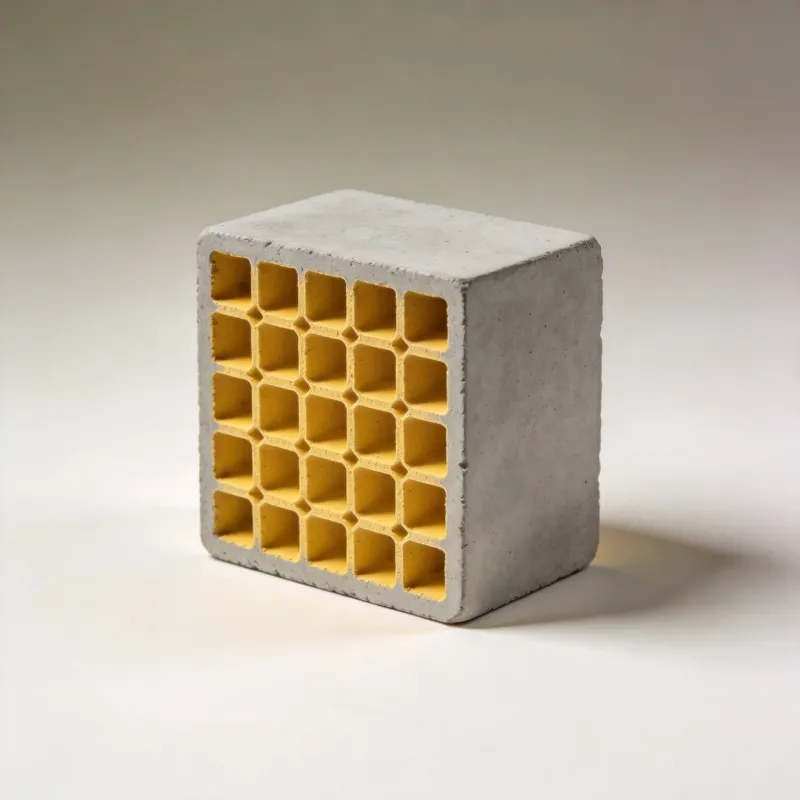
Honeycomb SCR DeNOx Catalyst
Extruded honeycomb SCR catalysts available in a wide range of cell structures, matched to dust loading, pressure drop and NOx removal requirements.
Overview
Honeycomb SCR catalysts are extruded with different cell densities and wall thicknesses so the catalyst geometry can be matched to the actual flue gas conditions — dust concentration, flow velocity and pressure drop allowance. The table below lists the standard structure range.
Technical Data
| Structure | cpsi | Pitch (mm) | Wall (mm) | Open area (%) | Specific surface (m²/m³) |
|---|---|---|---|---|---|
| 13×13 | 5 | 11.26 | 1.30 | 75.54 | 302.30 |
| 18×18 | 10 | 8.18 | 0.85 | 78.07 | 425.00 |
| 20×20 | 12 | 7.37 | 0.80 | 77.38 | 470.18 |
| 22×22 | 14 | 6.70 | 0.83 | 74.60 | 508.10 |
| 25×25 | 18 | 5.90 | 0.75 | 74.27 | 576.00 |
| 30×30 | 26 | 4.93 | 0.65 | 73.69 | 688.37 |
| 35×35 | 35 | 4.24 | 0.55 | 74.29 | 806.02 |
| 40×40 | 46 | 3.71 | 0.50 | 73.57 | 916.62 |
| 55×55 | 87 | 2.70 | 0.40 | 71.57 | 1124.53 |
| 60×60 | 100 | 2.48 | 0.38 | 70.73 | 1347.88 |
Values shown are manufacturer specifications or typical values unless marked (*). Parameters marked (*) are reproduced from source documentation and may contain unit or OCR ambiguities — they are reference values only and must be confirmed against the current product specification before use in engineering design. Design values are confirmed per project after operating conditions are reviewed. Please contact us for current data sheets.
Key Features
- Optimized pore structure
- Wide operating temperature range
- High specific surface area
- Good physical properties
- High chemical activity
- Good water resistance
Typical Applications
- Thermal power plants
- Steel and sintering flue gas
- Cement and building materials
- Industrial furnaces
- Low-to-medium dust NOx removal
Application Limits & Conditions
Customization
Cell density, pitch and wall thickness can be selected from the standard range above; module dimensions are customized to the reactor layout.
Data to Provide for a Quotation
To receive a material recommendation and quotation, please share your operating conditions:
- Gas flow rate (Nm³/h) and inlet / target outlet concentration
- Gas composition and main pollutant components
- Operating temperature and humidity
- SO₂ and dust concentration (where applicable)
- Existing reactor dimensions and current catalyst / adsorbent type
- Required service life and any special requirements
FAQ
Frequently Asked Questions
How do I choose the right cell structure?
High cell densities give more catalytic surface but lower open area and higher pressure drop. Low-dust flue gas allows higher cpsi; dusty gas needs larger pitch. We select the structure from your dust loading, flow rate and pressure drop budget.
What is the typical operating temperature window?
Standard V-Mo-Ti systems operate around 150–420°C. For other windows, the formulation can be adjusted — please share your actual temperature profile.
How do I read the cell structure table?
The table lists cell configurations from 13x13 up to 30x30 with pitch, wall thickness and geometric surface area. Larger pitch suits higher dust loading, while smaller pitch packs more surface area into the same volume; the choice balances pressure drop, dust tolerance and catalyst volume.
Which dust positions suit the honeycomb catalyst?
Honeycomb catalysts are generally applied in low-to-medium dust positions. For high-dust flue gas upstream of the dust collector, the plate-type catalyst is usually the better match.
How is service life managed?
Service life depends on fuel quality, dust, SO2 content and temperature excursions. Regular activity testing tracks performance decline so that regeneration or replacement can be planned before the emission limit is approached.
Discuss this product for your gas conditions
Send us your operating conditions — we will confirm applicability and return a material recommendation.